


Serotonin
Chemical name: 5-hydroxytryptamine, 5-HT
This is a well-studied monoamine neurotransmitter with 15 known receptor subtypes that provide it with the ability to impact the quality of life of the organism by way of neuromodulation. Serotonin is popularly known as the ‘Happiness hormone’ but its function extends further than just mood regulation – anxiety, cognition, digestion, sleep regulation, sexual behaviour and appetite can all be modulated by serotonin (Fig1.) as well as blood coagulation and more (5). Repetitive movements i.e. grooming/licking/chewing cause the serotonin neurons to activate (13,1). This article will be focusing on the effects of serotonin on the mammalian body, even though it remains present in all species, its effects vary between them. The greatest quantity of this molecule is synthesised within the enterochromaffin cells in the gastrointestinal tract and serotonin is then secreted into the bloodstream.
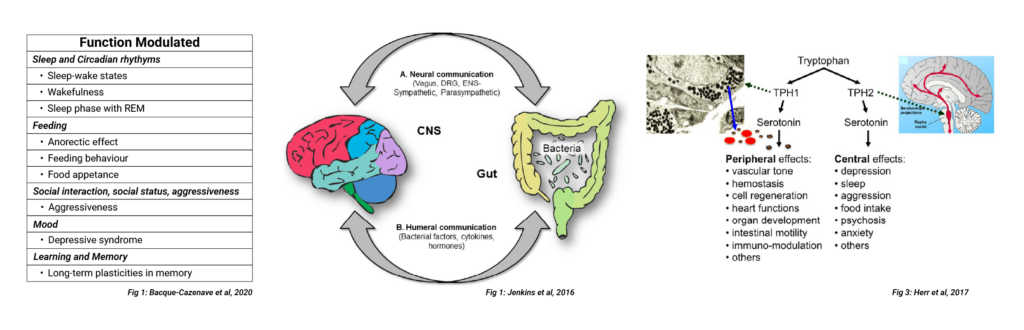
Serotonin is also produced in the central nervous system (Fig2.), so the majority remains platelet-derived in the circulating blood. CNS production is key as such a large molecule cannot cross the blood-brain barrier. Serotonin is quite complex as it has effects not only on the central nervous system but also as a hormone. This is where it plays a role in many of the animal’s physiological processes, in addition to the above, Tumour Necrosing Factor inhibition and stimulating cytokine secretion which provides immunomodulatory properties (2,5) (Fig3.).
This molecule can only be synthesised endogenously, it cannot be obtained in dietary sources. Instead, the essential amino acid, tryptophan, undergoes the process of hydroxylation and decarboxylation to create the serotonin molecule. If an individual has an imbalance in serotonin the mental, physical and social health can be affected (14,2).
Low levels
Serotonin depletion can occur due to a reduction of dietary tryptophan or to the competitive inhibition of tryptophan by high levels of Large Neutral Amino Acids (LNAAs) on their transport mediums across the blood brain barrier (9). Studies have shown that diminished circulating tryptophan levels and minimal dietary intake of this amino acid can contribute to increased observed aggressive behaviour and increased flight responses in confrontational situations (1). Not only does the depletion of serotonin have a significant impact on the animal’s reactions to certain situations but also influences impulsive/compulsive behaviours. If the serotonin level is low and a previously learned behaviour no longer received the same external response, this animal would be unable to prevent itself from consistently performing this behaviour whether its environment requires it to or not.
Less frequently, low tryptophan could also be the result of a tryptophan hydroxylase 2 (TPH2) enzymatic genetic mutation, where enzymatic activity and conversion reduces (Fig 3.)(11).
The resulting low levels of serotonin place these animals in a state of distress, leading to the development of maladaptive behaviours and an inability to successfully function(10).
Toxicity
It is also possible for the pendulum to swing the other way, where the serotonin level increases by such a significant quantity within the body that a clinical manifestation can be observed. This is a rare side effect of serotonergic medication, termed Serotonin Syndrome. In dogs and cats, the majority of cases present after the ingestion of human medication i.e. antidepressants (e.g. (MAOIs*, TCA[SCT1] s*), opioids (e.g. tramadol), serotonin-releasing ADHD medications or even human 5-hydroxytryptophan (5-HTP) supplements. However, other circumstances could be the cause of this development, such as an overdose of the animal’s own medication, if the medical history is not disclosed to the vet, this opens the possibility for additional serotonergic medication being added to the treatment plan (3).
Clinical signs of Serotonin Syndrome:
- Vomiting
- Diarrhoea
- Muscle twitches/rigidity
- Seizures
- Confusion
- Agitation
- Abdominal pain
- Coma
- Hyperthermia
- Ataxia
- Rhabdomyolysis
- Acute Kidney Injury (AKI)
- Disseminated Intravascular Coagulopathy (DIC)
Serotonin syndrome has the potential to be life threatening if not rectified quickly (14). In humans, the most common cases of this condition are caused by the excessive ingestion of Selective Serotonin Reuptake Inhibitors (SSRIs) (e.g. fluoxetines) and the most severe caused by MAOIs (e.g. seligiline hydrochloride). The pharmacodynamics of SSRIs work by preventing serotonin reuptake by binding to the pre-synaptic serotonin transporter, preventing relocation to the pre-synaptic neurone, to be released again, increasing inter-synaptic levels. The pharmacodynamics of MAOIs vary slightly, whereby the enzyme, monoamine oxidase is prevented from breaking down the serotonin, again increasing inter-synaptic levels (17).
Decontamination is required in cases of this condition via emesis induction and activated charcoal (1-2g/kg PO q4-6h if ingestion occurred <2 hours). Further treatment options consist of; intravenous fluid therapy, blood-urine-gastric content toxicology panels, benzodiazepines, early sedation, oxygen therapy, ventilation, cyproheptadine (5HT-R antagonist) and close monitoring of the animal’s vital signs (heart rate, pulse quality, respiratory rate, blood pressure, temperature etc) (3,12,16). In the human medical industry, it has been reported that opioids such as buprenorphine can increase serotonin levels within the body, so if the patient is on concurrent serotonergic medications, alternative analgesia options may be considered (15,8,18).
Conclusion
Serotonin is molecule that is in great demand by a multitude of body systems. If there is an imbalance in the production, circulating or storage levels, this significantly impacts the animal. Serotonin syndrome remains a rapidly developing, life-threatening condition that without the appropriate aggressive medical intervention can lead to a guarded prognosis. It is imperative that it is treated urgently and owners are educated on the clinical signs and the appropriate storage of medications in the home environment.
*MAOI = Monoamine oxidase inhibitors
TCAs = Tricyclic Antidepressants
References:
- Bacqué-Cazenave, J., Bharatiya, R., Barrière, G., Delbecque, J.-P., Bouguiyoud, N., Di Giovanni, G., Cattaert, D. and De Deurwaerdère, P. (2020). Serotonin in animal cognition and behavior. International Journal of Molecular Sciences, [online] 21(5), p.1649. Available at: https://www.mdpi.com/1422-0067/21/5/1649
- Bakshi, A. and Tadi, P. (2020). Biochemistry, serotonin. europepmc.org. [online] Available at: https://europepmc.org/article/NBK/nbk560856
- Barnette, C. (2023). Serotonin Syndrome. [online] VCA Animal Hospitals. Available at: https://vcahospitals.com/know-your-pet/serotonin-syndrome
- Fotuhi, M. (2021). NeuroGrow – Brain Fitness Center. [online] Neurogrow.com. Available at: https://neurogrow.com/serotonin–builds–your–brain/
- Galan, A.M., Lopez-Vilches, I., Diaz-ricart, M., Navalon, F., Pino, M., Gomez, E., Gasto, C. and Escolar, G. (2005). Serotoninergic Mechanisms Play a Major Role on Platelet-mediated thrombogenicity: Studies under flow conditions and effects of inhibitory strategies. [online] Ash Publications. Available at: https://ashpublications.org/blood/article/106/11/2636/120653/Serotoninergic-Mechanisms-Play-a-Major-Role-on
- Herr, N., Bode, C. and Duerschmied, D. (2017). The effects of serotonin in immune cells. Frontiers in Cardiovascular Medicine, [online] 4. Available at: https://www.ncbi.nlm.nih.gov/pmc/articles/PMC5517399/
- Hopkins, J., Pardo, M. and Bischoff, K. (2017). Serotonin syndrome from 5Hydroxytryptophan supplement ingestion in a 9-month-old Labrador Retriever. Journal of Medical Toxicology, [online] 13(2), pp.183–186. Available at: https://pmc.ncbi.nlm.nih.gov/articles/PMC5440317/
- Isenberg, D., Wong, S.C. and Curtis, J.A. (2008). Serotonin syndrome triggered by a single dose of suboxone. The American Journal of Emergency Medicine, [online] 26(7), pp.840.e3–840.e5. Available at: https://www.sciencedirect.com/science/article/abs/pii/S0735675708001186?via%%203Dihub
- Jenkins, T., Nguyen, J., Polglaze, K. and Bertrand, P. (2016). Influence of tryptophan and serotonin on mood and cognition with a possible role of the gut-brain axis. Nutrients, [online] 8(1), p.56. Available at: https://www.ncbi.nlm.nih.gov/pmc/articles/PMC4728667/
- Jijimon, F., Mehak, S.F. and Gangadharan, G. (2025). Biophysical Techniques in Biosciences. 1st ed. Oxon: CRC Press, pp.176–182
- Komleva, P.D., Izyurov, A.E., Khotskin, N.V., Kulikov, A.V. and Alhalabi, G. (2023). Effects of the combination of the C1473G mutation in the Tph2 gene and Lethal Yellow mutations in the Raly-Agouti Locus on behavior, brain 5-HT and melanocortin systems in mice. Biomolecules, [online] 13(6), p.963. Available at: https://www.mdpi.com/2218-273X/13/6/963
- Myers, A. (2022). Antidepressant Toxicity in Dogs. [online] www.petmd.com. Available at: https://www.petmd.com/dog/poisoning/antidepressant-toxicity-dogs
- Olivier, B. (2015). Serotonin: A never-ending story. European Journal of Pharmacology, [online] 753, pp.2–18. Available at: https://www.sciencedirect.com/science/article/abs/pii/S0014299914007389
- Olivine, A. (2024). Serotonin: Normal and Abnormal Hormonal Function. [online] Verywell Health. Available at: https://www.verywellhealth.com/serotonin-8682041
- Schmid, R.D. (2024). Principles of Toxicosis Treatment in Animals. [online] MSD Veterinary Manual. Available at: https://www.msdvetmanual.com/toxicology/toxicology–introduction/principles–oftoxicosis–treatment–in–animals#Prevention–of–Further–Absorption_v3348272
- Selman, J. and Millard, H.T. (2021). Recognizing and treating serotonin syndrome. dvm360, [online] 53. Available at: https://www.dvm360.com/view/recognizing-andtreating-serotonin-syndrome
- Simon, L.V., Keenaghan, M. and Torrico, T.J. (2024). Serotonin syndrome. [online] Nih.gov. Available at: https://www.ncbi.nlm.nih.gov/books/NBK482377/
- Togioka, B.M. and Patel, P. (2024). Buprenorphine and naloxone. PubMed. [online] Available at: https://www.ncbi.nlm.nih.gov/books/NBK603725/
- Zoe Hansen (2024). Serotonin: Normal and Abnormal Hormonal Function. Verywell Health. Available at: https://www.verywellhealth.com/serotonin-8682041